Wednesday, September 21, 2022

Yankee Conference (1972)

It's time to journey back 50 years to the Yankee Conference of 1972, a season in which the  league's six teams finished with a descending won-loss record, from 5-0 down to 0-5. This also was the last season of the YC in the original six-team alignment it had used since 1947; Boston University joined in 1973 and Vermont dropped out after the '74 campaign. (Compare that to today's successor, the CAA, where it's news if the league actually has the same teams in consecutive seasons!)

I miss the smaller, tidier Yankee Conference and often fantasize the America East Conference schools with football programs (Maine, UNH, Albany, Bryant) can form an America East football league with Rhode Island, UMass and UConn, reuniting five of the original YC members. (And let's face it: the latter two schools have no business playing in FBS, no matter how many times some Redditor defends UConn by saying, "BuT tHe FaCiLiTiEs ...") 

WARNING: I may be repeating a few things from previous posts. 

I've profiled a few other YC seasons: 1947, 1969, 19741982, 1996.

I took this photo from this fundraising page. Hope they don't mind!

Massachusetts, which I profiled in this post, was in the midst of a golden age, capturing its seventh title (sixth outright) in 10 years. This was the first season in which the school used the "Minutemen" nickname. (After discarding "Aggies," "Statesmen" and "Redmen" over the previous 40 years, UMass finally found a moniker that stuck.) Eight players —  QB Peil Pennington, WR Steve Schubert, T Thomas Mullen, G Clarence Brooks, FB Richard Cummings, DE Ed McAleney and CB Robert Parrott — were named all-Yankee Conference. The team outscored its foes 369-155 and crushed California-Davis in the Boardwalk Bowl, 35-14, after original foe Delaware chickened out (cluck, cluck, Hens!).

UMass' uniforms didn't change from the previous season, keeping the "UM" on the helmets the Minutemen had used since '70. After a one-year helmet change in '73, UMass went to the kick-arse Minuteman helmet in '74.


Connecticut finished second despite a losing record overall (one of the negatives of playing in a small league). The Huskies' only loss was a 49-16 thumping at UMass, which should tell you how much better the Minutemen were than the rest of the league. Their top player, kick returner/running back Eric Torklelson, later played seven seasons for the Green Bay Packers. End Rob Robustelli was the son of Pro Football Hall of Fame Andy Robustelli, of the late, great Arnold Terriers.

The uniforms were unique in that the Huskies wore names on the back, becoming the first YC team to do so. I always liked the clever logo: A football-shaped "C" with stitches inside.

By going 3-2 in YC play, the 1972 Vermont team was the last in program history to have a winning record in league play before the school pulled the plug two years later. The Catamounts featured a strong-armed quarterback in Earl Olson, a Rutland native, who ... well, let's let his UVM Hall of Fame bio tell the rest: "In 1972 he set Yankee Conference records for yards passing (1,033 in conference games) and passes completed (84) to earn all-league honors. He ranked third in the NCAA in passing yards per game and 10th in total offense. Olson, just 5-foot-11, was twice named the team MVP (1970 and 1972)." 

UVM wore a rather plain uniform, with a simple green "V" on a yellow helmet. (This would look pretty good on a helmet.) A year later, that all changed.

The coaching career of future College Football Hall of Fame coach Bill Bowes got off to a humdrum start at New Hampshire, where the Wildcats went 4-5 overall, 2-3 YC for the first of two straight seasons. (That changed greatly in 1975 and '76.) Running back Ed Whalen (no, not the Stampede Wrestling and Calgary Flames announcer) set a school record with 201 rushing yards against Springfield; his season total of 831 yards including four straight 100-yard games.

The Wildcats' uniforms were in a transition phase; at home, they still wore the older long-sleeve jerseys with the wildcat patch on the sides, but switched to a more streamlined design with shorter sleeves on the road. By 1974 both jerseys were in sync, identical to what the Cats wore in '75.

Maine went through a rough spell in the 1970s, and '72 was no exception. From what I've been able to gather, the Black Bears were the only YC team to not offer scholarships, a decision that produced a mixed reaction on campus — the pro-sports faction wanted scholarships so Maine could field more competitive teams, while the anti-sports crowd didn't want to give any free rides to the jocks. Anyway, Maine managed to win three games despite going the "pure" route.

The Black Bears changed their road uniforms in mid-season, dumping the bears-on-shoulders jerseys and red-trimmed socks for versions that's better matched what they wore at home.

Alas, I couldn't find a team photo for Rhode Island,
so this group shot will have to do.

Rhode Island, which presumably did offer scholarships, got less bang for its buck than Maine, failing to win a game in YC play. After roaring out to a 3-0 start, the Rams lost their final seven games. The 1973 Renaissance yearbook noted how young the Rams were (only eight seniors) and insisted "there seems to be hope for the future." (Rhody did leapfrog to second in the YC in '73).

The Rhody uniforms changed very little from what the Rams had worn since 1967, save for some minor changes in trim and use of sleeve numbers. A set of light blue pants debuted in 1973.

Sunday, September 18, 2022

Northeastern Huskies (What If?)

The second installment of our "What If?" series continues with Northeastern, which has been "undefeated" since it dropped the program after the 2009 season. As I've wisecracked before, the school probably dumped football only when it realized it still had a football team. I'm not sure in anyone on Huntington Avenue misses football (like many New England schools, hockey dominates the conversation), but for anyone who does, here's what the Huskies' uniforms might have looked like had they stuck around. 

2011: Reebok continues to make the Huskies' unis — they were one of the last teams to use Reebok at the time of the program's cancellation —  and they give Northeastern a template similar to the CFL's Montreal Alouettes (Reebok also made the CFL unis around this time).

2014: Nike takes over and makes some adjustments. The Huskies switch to the Nike Pro Combat template, but the jerseys retain some elements of the 2011 look. The "N" on the helmets is replaced by a paw, and the "retro" Husky (used on the hockey sweaters during this period) appears on the sleeves. Nike also introduces a unique dark gray-and-black alternate uniform, because Nike. A breast cancer awareness uniform features pink helmet trim and socks.

2017: The uniform becomes more streamlined and the jersey fonts are altered. A new black uniform with minimal red elements is added, with an oversized retro Husky on the helmet.

2019: The Huskies celebrate college football's 150th anniversary with a retro helmet and jersey honoring the 1963 Eastern Bowl team, which lost to East Carolina in Allentown, Pa.

2021: Under Armour, which makes Northeastern's hockey uniforms, takes over for football and gives the Huskies a uniform based on their hockey sweaters. The new Husky head logo blends into the black helmet. A rather bizarre all-white alternate uniform is added, with gray numbers, outlined in black, on an icy-white jersey.  

Monday, September 12, 2022

Stonehill Skyhawks (1970, 2013)

Stonehill, you say? Stonehill? Isn't it that goofy stone formation in England? Or an even goofier song by Spinal Tap? 

OK, enough with the silly wordplay; Stonehill College is a school in Easton, Mass., about halfway between Boston and Cape Cod. It's also the home of New England's newest Division I program, as the Skyhawks (known as the Chieftains until 2005) moved from the D-II Northeast-10 to the D-I Northeast Conference during the summer. And you know what that means — another football team to chronicle on this site, which I believe raises the total to 22. 

Stonehill first fielded a club football team in 1970. While the school's varsity teams wore purples and were called the Chieftains, this rogue outfit, which raised money by doing everything from holding raffles to washing airplanes, wore light blue and brown uniforms, bought secondhand from a defunct Long Island team, and dubbed themselves the Knights (the coach's name was David Knight). The team's lone win was against another club team, St. Michael's (Vt.), which had a varsity team on-and-off until the early 1950s.

I don't have any color images, so what you see above is a best guess based on the photo in the above link. The numbers vaguely resemble Clarendon font; Dartmouth's road jerseys used something similar in the early 1960s. The use of light blue, which contrast well with both dark and white jerseys, probably saved the team from holding a baker sale to buy a second set of shirts.

In 1988 the team graduated to varsity status and began playing in NCAA Division III that fall, moving up to D-II in 1997. The team has won three conference championships, most recently in 2013, when the Skyhawks shared the NE-10 regular season title with American International — only to lose to AIC in the league championship game. (Stonehill also lost to AIC in the regular season.)

The 2013 unis bear more than a passing resemblance to those of Holy Cross; that they both get their gear from Adidas probably is a factor.

Unfortunately, Stonehill has yet to put any old yearbooks online, so it may take a while for old uniforms to appear on this site. Although upon further review, I see some old media guides are online. ... 

Wednesday, September 7, 2022

Boston University (What If?)

One of my favorite uniform sites is Steven Grant Design, which features a treasure trove of ice hockey concepts, plus blank templates for those who wish to make and submit their own jersey designs. (Someday, I should unleash my Hockey East concepts!) Grant recently did a series of "What If" concepts for defect NHL teams like the Minnesota North Stars had they stayed put, while capturing the NHL's (often hilarious) fashion trends over the last 30 years. What does this have to do with football? Well I naturally began thinking about applying Grant's concept to defunct college football programs, which leads to this post.

What follows is a fictional timeline of what Boston University's uniforms might have looked like had the school decided to spare the program in 1997. You can check out the final-year unis here. I hope to eventually add Vermont and Northeastern. 


2000: The Terriers do some minor changes, making the sleeve logo match the official one (the '97 version had a more homemade look) and adding a tiny "BOSTON" wordmark. Russell replaces Wilson as the uniform supplier.


2005: Nike replaces Wilson, but few changes are made other than the "BU" replacing the uniform number on the helmets. (If you so a search for BU basketball and hockey, you'll see BU's uniforms across the board are pretty conservative.) The Terriers also sport a 1950s throwback uniform in honor of legendary football and baseball star Harry Agganis, who died 50 years earlier.

(I just realized I've never done the Agganis-era uniform for this site. I'll have to change that eventually.)

2008: The piping craze overtakes college football by this point, and BU is no exception, although the Terriers try to keep it classy. (Penn had a similar pattern around this time.) By this time, the red pants are gone, and the CAA patch replaces that of its predecessor, the Atlantic 10.


2014: Piping becomes as passe as it was trendy just a few years earlier, and BU ditches the weird stripes in favor of contrasting sleeve panels, a la New Hampshire. The Terriers also join the trend of placing a logo on one side of the helmet and a uniform number on the other. And speaking of trends, BU unveils a special breast cancer awareness uniform, along with a pink-tinged helmet.

Also note the addition of the Patriot League logo; the real-life Terriers joined the PL in 2013, and it's a safe bet they would have joined in football, too.


2015: Nothing changes except for the addition on an all-black alternate. The reaction from fans and alumni is swift and severe, and the unis are worn for only game before they are discarded and sold off at a spring cleaning sale a few years later.


2019: By this time, Under Armour is making the Terriers' uniforms, as it does for their other sports in real life. The contrasting panels are replaced by shoulder stripes, which makes the unis resemble Cornell's from about a decade earlier. An alternate helmet has a slightly oversized Terrier head. and a 1969 throwback uniform honors the 150th anniversary of college football and the 50th anniversary of BU's Pasadena Bowl team.


2021: Most of the designs, including the popular throwback, are still around, but a new alternate uniform replicates the BU hockey design, right down to the pants and socks. Which goes to show that even if football had stayed on Commonwealth Avenue, hockey likely would remain the top dog.

Friday, August 26, 2022

Inside the Jersey: Penn Quakers (1993)


A while back, I used to do an occasional feature where I'd unearth a jersey from my collection and explore the ins and outs of it. Well, this golden oldie somehow fell through the cracks in the AstroTurf. Let's dig in!

The Jersey: 1993 Penn Quakers throwback, worn for one game only (Nov. 20, 1993 against Cornell, the 100th meeting between the ancient rivals). I discussed the uniform a bit in this post. As far as I know, this was the first throwback uniform in college football history. It was worn with Penn's regular helmet and a set of blue pants slightly different from its usual pants, which had stripes on the sides. (Ironically, the original 1970s blue pants had stripes.)

Penn edged Cornell, 17-14, to wrap up a 10-0 season and the Ivy League championship.


How It Was Acquired: eBay, $35. A steal of a deal.

Who Made It: Rawlings, which also made this great Cornell jersey in the late 1970s. When I was young, Rawlings made all the Major League Baseball jerseys, but the company dabbled in football, too.

The mark of a pro ... or whatever college football players are these days.

Who Wore It: Two different players wore No. 64: Linebacker Tim Gage and offensive lineman Jamie Santiago. It's not uncommon for multiple players to simultaneously wear the same number; usually one player is on offense and the other is on defense. 

Size: The label reads extra large, but it's probably closer to 2XL or even 3XL. I can wear it comfortably with an undershirt underneath. Today's XL jerseys look like they're spray-painted on the players, they're so tight.

Jersey Constriction: Good old-fashioned made-in-the-USA mesh. No PrimeKnit-HeatGear-TechFit blarney going on here.

The Penn throwback jersey in all its glory. I forget where 
this photo came from, but thanks to whomever used it first.

Design: It's based on the excellent style Penn wore from 1971-80. The numbers and "PENNSYLVANIA" wordmark are taller than on the originals. The Quakers have used the alternating dark red-and-blue sleeve stripes off and on since the 19th century, making it one of football's most enduring uniform characteristics. 

Condition: A little yellowed on the top, with some small stains on the front — possibly from game action, more likely from its current owner eating wings while watching a game on TV.

Other Stuff: The dark red on the sleeves is much closer to maroon, but it seems to match what the Quakers were using on the helmets at the time.

Final Verdict: Let's see ... Historic significance, great design, still fits: Yeah, I'd say this shirt rules.

Friday, August 19, 2022

Yale Bulldogs (1954)

The latest pull out of the bag of random brings the 1954 Yale Bulldogs, a team that started strong and finished, er, not strong.

The Team: The Bulldogs roared out to a 5-0-1 start before dropping their last three games to Army, Princeton and Harvard to finish 5-3-1. The Boston Globe account of the Army game noted that the sellout crowd of 73,600 was the "largest to congest this big crater in 24 seasons." Ah, old-time sportswriting. Army's stellar season (No. 7 in both the media and coaches' polls) and proximity to New Haven (about 90 miles) likely explained the big crowd.

You know it's the Ivy League when the starting lineup 
shows up in semi-formal wear. Boston Globe photo.

The Players: Yale was not a team of superstars, but center James Doughan made the Associated Press All-East second team, while teammates Paul Lopata, Philip Tarasovic, Thorne Shugart and Dennis McGill were honorable mentions.

The Coach: Jordan Olivar guided the Bulldogs from 1952-62, going 111-63-8 and winning two Ivy League titles. He resigned after the '62 season when, according a Hartford Courant account, the school wanted him to live in New Have year-round and "give up a thriving insurance business in California." Before Yale, he also coached at Villanova and Loyola Marymount.

I've probably run this photo before, and it's actually from 1955,
but this picture of Yale players on the bench is too good to pass up.

The Uniforms: As noted in this post, Olivar brought his flashy California style to the Ivies, and that included gold pants, which the Doggies wore from 1954-58. As you can see in the photo above, the white helmets, blue shirts, gray trim and gold pants make for a mish-mash design, like when you play Madden and go all random with the uniform selection.

This was the last year Yale did not wear white jerseys, as the Ivy League insisted all teams wear contrasting jerseys by the time formal league play began in 1956. Plastic helmet shells were in use, but facemasks were still a year or two away.

The Fallout: Yale went 7-2 the next year and 8-1 in 1956 to win the first formal Ivy League title. Olivar's best year came in 1960, when the Bulldogs went 9-0 and finished No. 14 in AP poll and No. 19 in the coaches' poll.

Sunday, July 31, 2022

Columbia Lions (1968)

Whether you're a fan of sports history or American history, 1968 was an interesting year.

Columbia University was in the news quite a bit that year, and 99% of the time, it wasn't for football

A hotshot Ivy League quarterback was the talk of college football, and 99% of the time, it was this guy.

Although student protests and Brian Dowling dominated the headlines in Ivy-ville, a Columbia quarterback was making a name for himself. Marty Domres, an Ithaca, NY, native who opted for Columbia over his hometown Cornell Big Red, set at least 10 school records during his three years under center, and a Columbia Daily Spectator article from '68 said he set 31 school, league, regional and national records overall. 

Marty Domres. What's interesting is that he's wearing the 1970-73 uniform in this picture,
although he played at Columbia from 1966-68. Looking through Spectator archives, it appears
the Lions may have worn these for preseason headshots only.

His numbers appear quite modest in retrospect: His 4,492 career passing yards would have been third in FCS football for just the 2021 season. In a 46-20 season-ending win over Brown, Domres set Ivy records for attempts (54), completions (30) and yards (396), numbers regularly surpassed on any given Saturday. But as I've droned on more times than I care to remember on this little ol' blog, the QB's best pass was a handoff to the running back in those olden times. But Columbia, being bereft of talent, attached itself to Domres' rocket arm and let it fly. And when Domres wasn't throwing the ball, he usually scooped the ball under his arm and ran with it (198 rushing yards, 6 TDs) whenever his offensive line melted, which was often. 

Domres, right, lets 'er rip in the season finale against Brown.

A 44-16 loss to Princeton in Week 2 might sum up Domres' career best. Domres, "throwing from a roll-out, from a drop back pattern and lying on his back," in the words of the Daily Princetonian,  was 28-for-53 for 372 yards and a TD pass (not to mention five of his 15 interceptions that season). Quoth the Columbia Daily Spectator: "On almost every pass, the senior quarterback was demolished immediately after releasing the ball, and there were several occasions when you simply knew he wasn't going to get up. But he did. ... Domres' scrambling, passing and apparent sense of masochism with regard to defensive linemen scored high marks ..." No wonder he drew an ovation from the Princeton fans at Palmer Stadium when he walked off the field for the final time. 

Domres runs for his life — again — vs. Princeton.

While Domres was one of two QBs named to the all-Ivy team (Dowling was the other), he lacked Dowling's supporting cast, and the Lions went 2-7 for the third straight year. (In 1969, without Domres, Columbia slipped to 1-8.) Domres was a first-round draft pick of the San Diego Chargers in the 1969 NFL/AFL draft and was a backup for three years until 1972, when he was dealt to the Baltimore Colts and became the answer to a trivia question: Who replaced John Unitas as the Colts' QB when Johnny U was benched?

Under first-year coach Frank Navarro, Columbia's uniforms ditched 1965-67's rather busy look. Light blue pants and the faux-New York Jets jerseys were out, replaced with a simpler design used until 1970, when shoulder stripes were added ... although if you look at the above photo of Domres, you'll see the 70s shirts were hanging around, at least in the preseason.

I found this on Reddit while doing a Google search 
for anything Domres-related. Umm ...


Saturday, July 23, 2022

Colgate Raiders (1964)


All right, we're overdue for a reach into the bag 'o random, and we pull out the 1964 Colgate (Red) Raiders. 

The Team: The 'Gate went 7-2, good enough for third place among "major" independents, although six of the Raiders' nine foes are FCS teams and a seventh (Merchant Marine) currently plays in Division III. And speaking of the Mariners, the sons of King's Point fell to Colgate 21-0 in the first college football game played at Shea Stadium. According to this list, only five other college games were ever played at the old home of the J-E-T-S. 

Not your typical team photo, as the Raiders line up 
in a "V" formaton.

Colgate gets defensive against Merchant Marine at Shea Stadium.

The Players: Quarterback Gerald Barudin threw for 605 yards and ran for 200 more, while Lee Woltman ran for 402 yards and caught for 192 more. Peter Beaulieu had a team-high 347 receiving yards in that run-first, pass-later era.

The Coach: Hal Lahar was in his second stint at Colgate following a .500 run at Houston; he apparently was the first coach in "major" college history to serve two separate stints at the same school, not counting guys like Frank Leahy who served in World War II. He was 53-40-8 at Colgate from 1952-56 and 1962-67 before he stepped down to become athletic director.

The Uniforms: Were it not for the white shoulder stripes on the home jerseys, Colgate's unis would almost be dead ringers for Alabama's. It's definitely one of the simpler styles of that era, even by 1960s standards. The Raiders wore sleeve numbers on the road, but not at home. 

Colgate (in white) chases down Holy Cross in '64.

The Fallout: The 'Gate went 6-3-1 in 1965 and 8-1-1 in '66 (future Oakland Raider running back Marv Hubbard was the Colgate Raiders' big star) before collapsing to 2-8 in '67, when Lahar stepped down.

Sunday, June 26, 2022

Dartmouth Big Green (1952)

The latest dip into the bag-o-random gives us the 1952 Dartmouth Big Green, during a real dry spell for the program. 

The Team: Dartmouth went 2-7, the second of six straight losing seasons. The wins were over Rutgers (decades before that meant anything) and Columbia. A funny aside: As the Ivy schools were making plans for formal league play later that decade, they agreed in '52 to abolish spring practice. Even though Dartmouth played six Ivy teams that year (the exception was Brown), the Aegis yearbook trotted out the lack of spring practice as a reason for Dartmouth's poor record (another being that classic old-time chestnut, "bad breaks"). The Dartmouth Alumni Magazine was a little more blunt: "While there are no All-Americans on the squad, there are nonetheless some fairly talented players; but for some reason they don't function together as a unit, or the spark in most cases doesn't seem to be there."

I forget if I've run this photo before (probably), but this is a spectacular shot, between the action,
the expression on the player's face and, of course, the official's peaked cap.

Legendary sportswriter Dick Schapp was a Cornell undergrad when
he covered the Big Red-Big Green game for the Cornell Daily Sun.

The Players: It appears what few strengths Dartmouth had were on the line, as guard Pete Reich and tackle George Rambour were named to the United Press' All-New England team. Jim Miller did most of the passing at quarterback when not handing the ball off to Russ Smale, who in a 38-14 win over Columbia caught a 43-yard TD pass, returned a punt 60 yards for a score and intercepted a Lion pass.

The Coach: I touched upon DeOrmand "Tuss" McLaughry in this post about his Brown "Iron Men" teams of the 1920s. He guided Dartmouth from 1941-42 and 1945-54, serving as a colonel in the U.S. Marine Corps in 1943-44. In 12 years with the Big Green, he had only four winning records, the last in 1949. For those Upper Valley residents who remember the McLaughry real estate clan, yes, they are descendants of Tuss, who lived in the area until his death in 1974.

Tuss McLaughry (standing) takes in the action in '52.

Tuss and captain Pete Reich, an all-New England lineman.

The Uniforms: I've discussed these in a few other posts, but green and silver was the order of the day. Different fonts were used on the home and road unis. Cornell used a similar helmet design, which sometimes makes it challenging to figure out which team is which in those grainy black-and-white newspaper photos.

The Fallout: After two more dreary seasons, McLaughry was let go and Dartmouth brought in Bob Blackman, who turned the program around in a jiffy and won seven Ivy League titles.

Thursday, June 23, 2022

Delaware Blue Hens (2000)

The latest pulls from the grab bag and the random number generator give us the 2000 Delaware Blue Hens, one of the better non-title teams in that program's esteemed history.

The Team: The Hens went 12-2 overall and 7-1 in Atlantic 10 play, sharing the league title with Richmond (which Delaware defeated 24-17, which leads to this thought: Since the Hens defeated the Spiders in the regular season, why did they have to share the league title? Why not use tiebreakers, a la the NFL?). Delaware outscored its foes 570-238, surpassing the 40-point mark eight times. The topper was an 84-0 nail-biter over West Chester, a poor D-II team that was shut out four other times that year. (The Golden Rams must have been hard up for cash to take that body bag game.) 

The Hens crushed Portland State and Lehigh in the I-AA playoffs before falling to Georgia Southern, 27-18 in the semis.

A 2000 (Wilmington) News Journal front page spreads the good news. 

The Players: Three Hens — Brian McKenna (LB), Jamin Elliott (WR) and Jeff Fiss (OL) — were named I-AA All-Americans and all A-10, and McKenna was named A-10 defensive players of the year. Matt Nagy (QB), Chris Phipps (OL) and Mike Cecere (DL) also made the all A-10 first team. Nagy remains the school's all-time leader in passing yardage (8,214) and passer rating (146.74; what, you thought that Flacco guy held all the records?).

The Coach: Tubby Raymond, of course, is an all-time legend, going 300-119-3 from 1966-2001. Some fun trivia about Tubby:

1) He was the head baseball coach at Maine from 1952-54 and Delaware from 1956-64, going 164-72-3.

2) He played two years of minor league baseball.

3) He loved to paint and created pictures of senior players every year.

4) His son Dave was the original Phillie Phanatic. These days, he's a motivational speaker.

The Uniforms: Like Raymond, Delaware's unis were a constant, having undergone minimal change since the 1950s save advances in helmet/jersey technology. After Raymond left, the Hens experimented with their look more, adding stripes and giving their blue and gold a noticeably lighter tone. You can see last seasons unis here for comparison.

The Fallout: Delaware fell to 4-6 in 2001 as Raymond struggled to earn his 300th win. But his successor, K.C. Keeler, took the Hens to the I-AA national title in 2003. Keeler also won a title at Sam Houston State (2020-21), making him the only coach to win FCS titles at different schools.

Monday, June 6, 2022

Penn Quakers (1990)

This week's random team is the 1990 Penn Quakers, during a speed bump amid their 35-year run of dominance of the Ivy League.

The Team: Penn went 3-7 overall, 3-4 in Ivy play. After a 16-6 opening day win over eventual co-champ Dartmouth, the Quakers lost their next three games (all non-league), then beat Columbia to go 2-0 in Ivy play. But Penn dropped its next three games to fall out of the race.

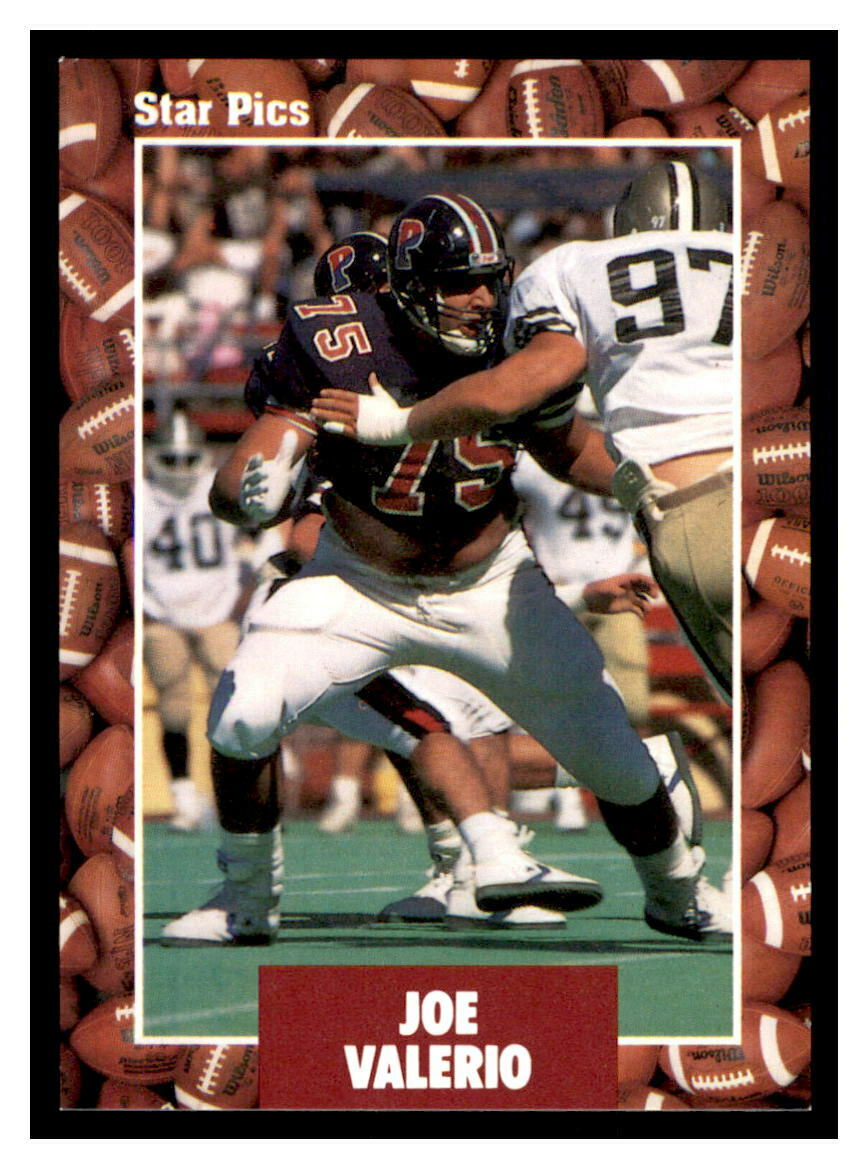
The Players: Despite the blah record, Penn came up with the Ivies' only I-AA (FCS) All-American that year, offensive lineman Joe Valerio, who played for the Kansas City Chiefs from 1991-95. He also was used as eligible receiver in short-yardage situations, and thus has one of the most unique stat lines in NFL history: 4 catches, 7 yards, 4 touchdowns — 3 from Joe Montana. And you can see 'em here.


Back in the "junk wax era" of early 90s sports cards, many fly-by-night companies
came, spat out a set or two, and vanished almost as quickly as they came. Two of those quickies, Wild Card and Star Pics, put Valerio in their prospects sets ... and even used the same photo!

Valerio was an all-Ivy first-team selection, as were Joe Kopcha (LB and Rob Sims (P). Mohamed Ali (WR) and Eric Poderys (DL) earned second-team nods.

The Coach: Penn has had five coaches since 1981: Jerry Berndt, Ed Zubrow, Gary Steele, Al Bagnoil and Ray Priore. Steele, who went 9-21 from 1989-91, is the only of the bunch to not win an Ivy title. In fact, every other coach on the list won at least two championships.

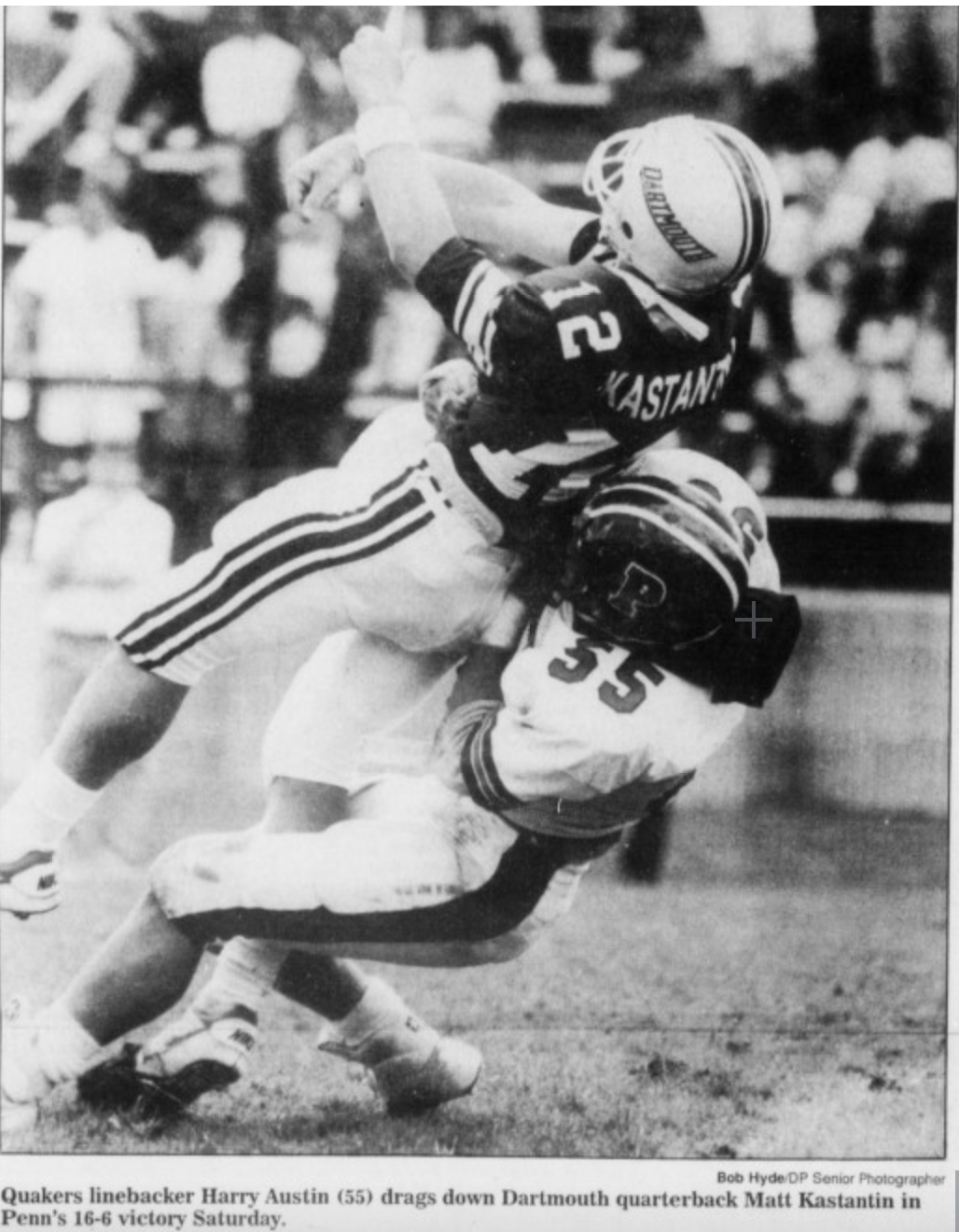
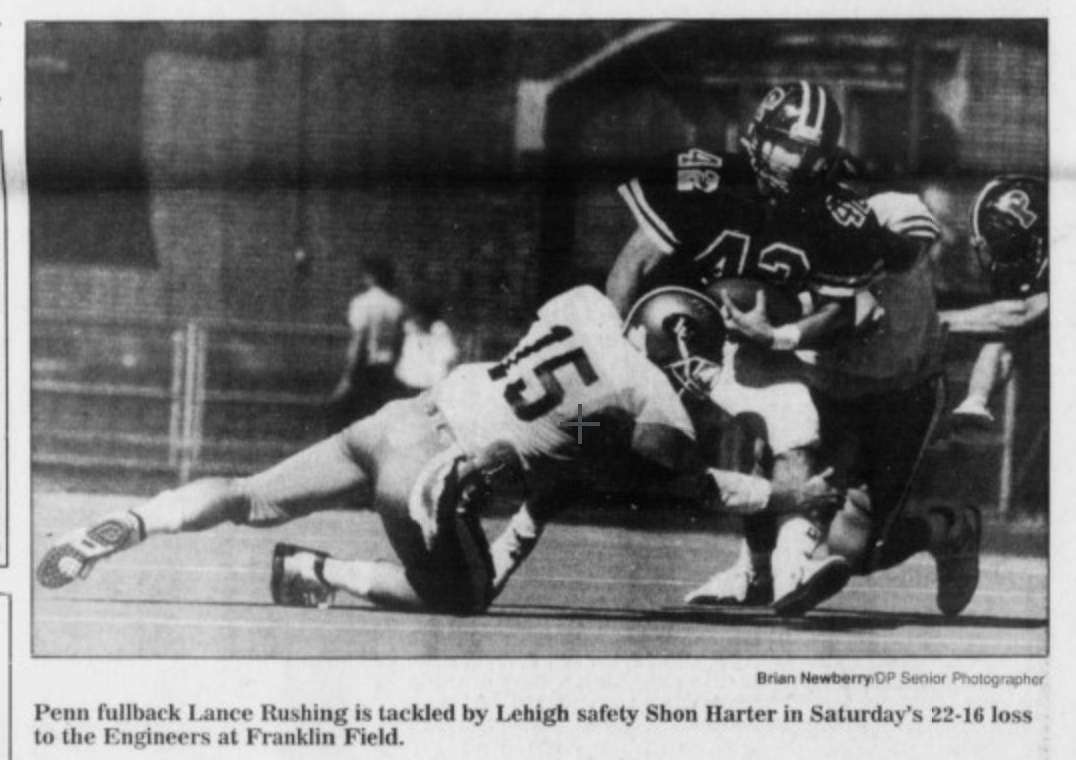
The Uniforms: Penn continued to use the same style it had worn since 1981; the only difference  was a reduction in the sleeve stripes. The split-P logo looks great even on a bad team. Penn wore white jerseys for its home opener against Holy Cross, a rarity even today outside of Georgia Tech or LSU.

Penn's Harry Austin performs a suplex that
would put Scott Steiner's to shame. Almost.


Stripes were on their way out by the early '90s, and 
Penn's uniforms reflected that trend.

The Fallout: The Quakers endured one more bad season under Steele before turning to Bagnoli, who went 7-3 in 1992 and went undefeated in '93 and '94 on his way to becoming one of the GOATs of FCS football.