Thursday, April 21, 2022

Connecticut Aggies (Huskies), 1919

The 1919 season should have been a happy one for the University of Connecticut's football program. After all, the Aggies (their name before Huskies was adopted in the 1930s) were back on the field after sitting out the last two seasons because of World War I, and like the rest of America, they badly wanted was a "return to normalcy."

Alas, it wasn't meant to be.

Gardner Dow was a Connecticut sophomore and a veteran of the U.S. Navy Reserve who was supposed to miss the Aggies' season opener Sept. 27 at New Hampshire with a bad ankle, but he decided to play anyway. During either the third or fourth quarter, depending on your source, Dow launched a flying tackle at New Hampshire ballcarrier Earl Farmer, who had been tripped up by the Aggies' Eddie Vorhees. Dow and Farmer collided in midair, and Dow's head struck Farmer's knee. Farmer got up; Dow did not. He died that night without regaining consciousness.


Newspaper reports on the death of Gardner Dow.

Three days later, classes and all other school activities were canceled while memorial services were held for Dow in his hometown of New Haven. On Oct. 6, the school renamed the field in his honor; Gardner Dow Athletic Fields, which housed several sports on campus, remained UConn's gridiron home until 1953.

The Aggies voted to continue the season in Dow's honor, and perhaps not surprisingly, they did not play well, losing their first six games before season-ending wins over Boston University and Rhode Island gave them a 2-6 record. Dow's death was college football's only on-field fatality of 1919; while the sport had come a long way toward cleaning up the game following the disastrous 1905 season, when 19 players reportedly died from on-field injuries, Dow served as a reminder that in football, danger is always right around the corner.

***


A group shot and a team shot of the 1919 "Aggies."

Connecticut's uniforms were typical fare for the era, with Princeton-style stripes down the sleeves. I can't tell if the Aggies wore numbers on the back based on the handful of existent photos, so for now they will be left blank. A couple years later, Connecticut decided to wear orange uniforms to stand out from blue-clad foes such as New Hampshire, Maine and Trinity.

UConn's 1920 Nutmeg yearbook was dedicated to the memory of Gardner Dow.


Thursday, March 24, 2022

Rhode Island Rams (1984-85)


Amazingly, I've never devoted a post to these guys, the last Rhode Island football teams to experience postseason play. In the vast field of weeds that has been Rams football over the last 50-60 years, the 1984-85 bunch, who went 20-6 and reached the NCAA I-AA (now FCS) Tournament twice, are the two magnificent roses to bloom from the crabgrass. Thanks to a big-armed quarterback, Rhody took its fans on a magical ride that old-timers likely still talk about today.

First, some quick backstory: In 1976, coach Bob Griffin took over a team that was low in wins (just two in 1975) and money, to the point that the school had considered canceling the program one year after Yankee Conference rival Vermont did the same thing. Instead, Rhody put its faith in Griffin, who rewarded the school and the fans with five teams that finished .500 or better from 1977-83, capped with a trip to the 1981 I-AA tourney.

But the fun was just beginning in Kingston.


Tom Ehrhardt "Ehrs" it out against Boston University and UMass in 1984.
All the photos here are from Rhody's Renaissance yearbook.

In 1984, a junior transfer from C.W. Post named Tom Ehrhardt arrived. The 6-foot-3, 205-pound gunslinger took his arm to Rhody because he like Griffin's pass-heavy offense, according to an article in the 2005 Rhody media guide (the source of much of the information for this piece). After a slow start, Ehrhardt put up numbers that stand out even in today's offense-heavy times — 410 yards and 5 TDs in a win over Brown, followed by 408 yards against UMass and 425 against Northeastern. Ehrhardt finished the season with 3,870 passing yards, which set a school single-season AND career mark, to go with 36 touchdowns. The only warts on his record were 20 interceptions (a little foreshadowing here). 

Ehrhardt's favorite target, tight end Brian Forster, caught 100 passes for 1,357 yards and 12 TDs, while wideout Dameon Reilly had "only" 58 catches for 902 yards, but a team-high 14 TDs. 

I'm not sure if Griffin ran the run-n-shoot (this was around the time the USFL's Houston Gamblers made it a chic offense), but those numbers are quite run-n-shooty.

Tom Ehrhardt and coach Bob Griffin talk strategy.
My guess is Griffin's saying, "throw the ball early and often."

Ehrhardt's name (trounced AIR-heart) was a field day for punny headline writers, who made copious references to Rhody's "Ehr-force," "Ehr-attack" ... you get it. 

In a loaded Yankee Conference race that featured three teams in the I-AA top 20, Rhody shared the league title with Boston University (each went 4-1 in YC play) and earned a first-round bye for the 12-team NCAA tourney.

After edging Richmond 23-17 in the quarterfinals, Rhody headed to Montana State (a national power then and now) for the semifinals. The Rams led 20-18 and were deep in Bobcat territory with five minutes left in the fourth quarter. Instead of running out the clock, Ehrhardt threw ... and Montana State's Joe Roberts intercepted the ball and ran it back for a pick-six in an eventual 32-20 Bobcat win. You can see the clip — with Eddie Robinson on commentary — and read more about the game here.

Just to show that Rhody did, indeed, run the ball on occasion,
here's Richard Kelley rushing at Northeastern in 1984.

Ehrhardt and pals were back for more in 1985, and they put up even more ridiculous numbers. OK, maybe Ehrhardt didn't make "people forget about Doug Flutie," as Rhody's Renaissance yearbook breathlessly claimed, but he still threw for 4,508 yards despite missing all of one game and most of another with a hip injury. Only two Rhody QBs, not including Ehrhardt, have ever thrown for more yards in an entire CAREER. He also threw for 42 TDs (only one other Rhody QB has thrown for more in a career), highlighted by eight scores and 566 passing yards in a 56-42 win over UConn to clinch the Yankee Conference title with a 5-0 mark. (No truth to the rumor a young Mike Leach was at the game taking notes.) The only bad thing? His 27 interceptions (cue ominous music). Forster caught 128 passes for 1,819 yards and 17 TDs; against Brown, he had 18 catches for 327 yards. About 20 years earlier, that would have been considered a good season.

The late Brian Forster after hauling down one of his 128 catches in '85.

Fellow tight end Tony DiMaggio makes a catch against Maine.
He finished the season with nine TD receptions.

In the first round of the NCAA tourney, Rhody defeated Akron 35-27 behind Ehrhardt's 43 completions (still a school record) for 472 yards and five TDs. But it all came crashing down in the quarterfinals a week later as Ehrhardt threw six interceptions in a 59-15 loss to Furman.

The graduation of Ehrhardt, who still holds 15 school passing records, marked not just the end of an amazing career, but a fun era for Rhody football; the Rams went 1-10 in each of the next two seasons and have had just five winning seasons since, not counting the spring 2021 COVID season. 

New England is a region where college football often plays second fiddle to the Patriots or the high schools. But once in a while, a Doug Flutie or a Ricky Santos or a Tom Ehrhardt will come around to capture the region's imagination. It would be nice if another "Ehr-attack" arrived to get fans talking again.

Bonus No. 1: Griffin, Ehrhardt and others talk about the vintage Rams here.

Bonus No. 2: Quite possibly the most 80s sports TV intro here.

Saturday, March 12, 2022

Cornell Big Red (1990)

Someone requested this one a while back, so let's take a glance at Cornell's third (and to this date, last) Ivy League championship, following titles in 1971 and '88.

The team: The Big Red went 7-3 overall and 6-1 in Ivy competition to share the title with Dartmouth, which beat Cornell by the baseball-like score of 11-6 on Oct. 20. The Red's other losses were to Colgate and Bucknell in non-conference action; the lone non-conference win was over Lafayette. According to this handy season summary, Cornell led the league in rushing (249.2 yards per game) and total offense (375.0) and outscored its foes 180-95.

The players: Cornell was all about the ground-n-pound on offense, as John McNiff ran for 998 yards and 10 TDs while Scott Oliaro added 744 yards and nine scores. McNiff was named to the all-Ivy League first team as were offensive linemen Jay Bloedorn, Chris Field and Greg Finnegan; Olioaro was a second-team selection. Quarterback Chris Cochrane threw only five touchdown passes, but he also threw only five interceptions.

Chris Cochrane, shown in practice, was an effective
game manager for Cornell. Y'know, I don't think
"game manager" is a dirty phrase.

On defense, lineman Tim Cronin was named first-team All-Ivy, while Mark Broderick (LB), Gerry Willinger (DB) and Paul Tully (DB) were named to the second team.

Scott Oliaro (22) holds onto the ball against Brown, c. 1990.

The coach: First-year coach Jim Hofher, a former Cornell quarterback, went 45-35 at his alma mater from 1990-97 before he left to take an assistant position at North Carolina. Most of his teams usually went 6-4 or 4-6, so they were at least competitive. He later coached Buffalo, whose inept transition from FCS to FBS has been surpassed only by UMass, from 2001-05, going 8-49.

The uniforms: Cornell's unis still had some traces of the old Bob Blackman look from a decade earlier, specifically the chunky stripes on the sleeves and pants. But other elements, like the "CORNELL" wordmark on the jerseys and helmets, were long gone. Cornell wore names on the backs during this era; Dartmouth was the only other Ivy team to do so. The big "C" remains on the helmets today, although several modifications have been made over the years.

The fallout: Cornell continued to pump out decent teams during the Hofher era, although the Big Red never won the Ivy title again. His successor, Pete Mangurian, went 16-14 from 1998-2000 before he made Columbia scary bad from 2012-14 (3-27).  

Thursday, February 17, 2022

Harvard Crimson (1957-58; 1971-72, 75; 1994)

Stability is a funny thing in football. Some teams change head coaches more often than their jockstraps (Columbia pre-Al Bagnoli, Maine pre- and post-Jack Cosgrove come to mind), while others have the same coaches year in, year out. New Hampshire recently hired Ricky Santos as its new coach; he's just the Wildcats' third leader since 1972. The Pittsburgh Steelers have had only three coaches since 1969. 

Which brings us to Harvard.

The Crimson have enjoyed the services of three coaches since 1957, 65 years ago as of this writing. Sixty-five years before 1957 was 1892, the heyday of helmetless players, the flying wedge and mass-momentum plays. John Yovicsin, Joe Restic and Tim Murphy have been pillars of stability in Cambridge during that time and — not coincidentally — have won plenty of Ivy League titles (17 through 2021, roughly one every four years). 

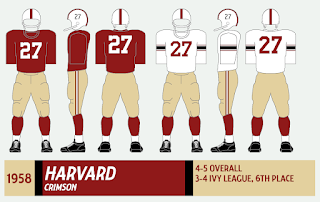
Let's take a look at the uniforms the Crimson wore during the early seasons of each coach's reign, as they all made some changes upon or soon after their arrival.


John Yovicsin was hired in 1957 from Gettysburg, his alma mater, where he went 32-11 over five seasons. After a couple rough seasons at Harvard, Yovicsin guided the Crimson to a 6-3 mark in '59 and Ivy titles in 1961, '66 and '68. His high point as a coach was probably the 29-29 "win" over Yale in 1968 that's been the subject of just a few books and flicks over the years. He retired after the 1970 season because of heart issues. 

John Yovicsin's bio from the 1963 Harvard media guide. 

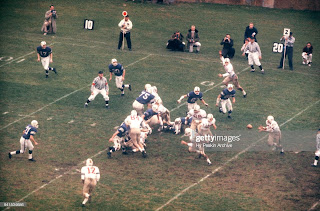
Harvard (in white helmets!) faces off with Yale in 1958.
Note the black-and-crimson stripes on Harvards jerseys.

Yovicsin's first-year unis stayed the course from previous seasons, but took a left turn in '58 with the addition of white helmets after decades of crimson lids. In '61 Harvard took it to another level with bizarre half-crimson, half-white helmets before returning to crimson in '64.

Speculation was abound over Yovicsin's possible successor. The Jan. 4, 1971 Harvard Crimson newspaper said "a relatively unknown man" would be hired as coach that day, and noted the rejected candidates were Ralph Jelic, Yovicsin's defensive coordinator, and Frank Ryan, the Cleveland Browns quarterback-turned math professor (fitting for an Ivy school, of course).  

The relative "unknown" turned out to be Joe Restic, formerly the head man of the CFL's Hamilton Tiger-Cats (22-17-3 record). Restic soon became very well known around Harvard, going 117-97-6 from 1971-93. He won five Ivy titles and went 10-13 against Carm Cozza and Yale (the 26-year war?). His "multiflex" offense, a whirlwind series of complex plays, formations and last-second shifts, was later the subject of its own class at Harvard.

Harvard's 1971 media guide heralds the arrival of 
new coach Joe Restic, in groovy Helvetica font.

The first-year Restic uniforms were identical to the later Yovicsin versions, put replaced the jersey number with a plain "H" in 1972. In '74, Harvard wore helmets with the "Real Football Centennial" logo (designed as a raspberry to rival Princeton, by my guess) and switched to the H-in-a-hockey-rink logo in '75, albeit with the logo on only one side for couple years. In 1980, the classic jersey with the school seal on the shoulders debuted; the 1988 unis can be found here.

After Restic's retirement in 1993, Harvard turned to Tim Murphy, who had turned around Cincinnati from back-to-back 1-win seasons in 1989-90 to an 8-3 mark in '93. Despite the success story in Cincy, Murphy departed the FBS Bearcats for the FCS Crimson, a curious decision not unlike Joe Yukica's decision to leave Boston College for Dartmouth in 1978.

But there's no arguing with the results. Murphy is by far and away Harvard's winningest coach, with 186 wins and nine Ivy titles, including three undefeated seasons. Murphy also is the fifth-winningest coach in FCS history (210 wins between Harvard and Maine). A few more big seasons, and the FCS record of 242 victories might be in sight.  

Tim Murphy's Harvard debut was a 39-32 win at Columbia.

Murphy made one significant change to the uniforms upon his arrival: He ditched the hockey rink logo for a more modern H, black and bold and serifed. The height and width of the H changed a few times and the helmet stripes eventually departed, but the rest of the uniform remained largely the same until 2021's overhaul

Wednesday, February 9, 2022

Joe Yukica 1931-2022

Joe Yukica, who coached New Hampshire, Boston College and Dartmouth from 1966-86 and quickly improved the fortunes of all three programs, died recently at the age of 90. Having worked in Dartmouth's backyard for more than 15 years, I heard many stories about Yukica, particularly concerning his messy departure from the Big Green. (Long story short: He was asked to resign in 1985 with a year left on his contract, he took Dartmouth to court and got JOE PATERNO to testify on his behalf; in the end, Yukica was allowed to coach Dartmouth in '86 and finish his contract.) 

My old Valley News colleague Jim Kenyon, who covered the Big Green in the '80s, wrote this excellent profile on him a few years ago.

Anyway, I thought I'd take a look at the uniforms of Yukica's teams, as he made significant sartorial changes to all of his teams upon taking over. Much of this has been repeated elsewhere on this little ol' blog, so you'll have to bear with any redundant redundancies. 

New Hampshire, coming off a winless 1965, hired Yukica from Bob Blackman's staff at Dartmouth, where he coached the Big Green ends for five seasons. 

Yukica turned the Wildcats around, going 2-6 in 1966 and ending an 11-game losing streak in week three (against Maine ... of course). The '67 bunch improved to 5-3, with the losses coming by a combined nine points, causing the Granite yearbook to comment that students "may even come to realize what a rally should be like. The first one last fall was so poorly attended that the students barely outnumbered the players." (Of course, this was 1967, and students were too busy concerning themselves with evil and social injustice to worry about a little ol' football team.)
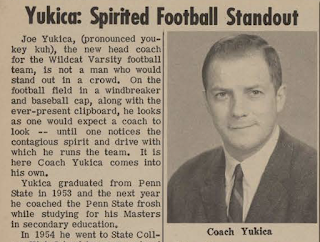
A 1966 article from The New Hampshire student paper
introduces Wildcat fans to Joe Yukica.

New Hampshire ends a long losing streak against Maine in '66.

The uniforms underwent some modifications from '65's winless team, most notably with the road jerseys, which lost the contrasting blue sleeves. The helmet numbers, meanwhile, were moved to the sides from the back. (In '66, the numbers were only on the right side of the helmets.) In fact, the uniform has a very Penn State look to it. Care to guess where Yukica played his college ball? Judging by photos I've seen, the striped socks weren't worn as much as the short, white models.

After Yukica engineered such a quick turnaround in Durham, it was only a matter of time before a bigger school came calling, and he took the 75-mile trip south to Boston College, coming off back-to-back four-win seasons. Yukica won six games his first season at The Heights, and had only one losing season in 10 years while going 68-37. Yukica also upgraded the Eagles' schedule, adding meatier fare such as Texas and Notre Dame after BC had spent years playing small Jesuit schools like Detroit Mercy and Marquette, both of whom dropped the sport in the '60s.


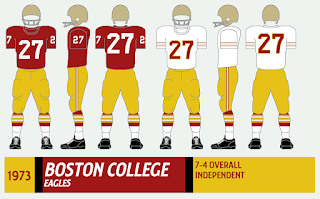
A sampling of Boston College's uniforms during the Yukica era.

The BC uniforms under predecessor Jim Miller (1962-67) had a USC look to them: Red shirts with big, yellow numbers and thick, yellow-and-white stripes. Yellow (or, if some of you prefer, gold) pants complete the look. In 1966-67, the jerseys had a uniform number on one sleeve and an eagle on the other. In '68, Yukica went to a very plain design with jerseys that look more at home on a practice field. Like the schedule, those eventually got an upgrade and evolved into the style very similar to those used in the Flutie years.

A Boston College punter boots away in '68.

BC coach Yukica and quarterback Frank Harris
chat in the locker room after a 1970 win over Holy Cross. This and
the photo the top of this post come from Digital Commonwealth, one of the best
time-killers you'll ever find. Note the plainness of the BC jersey.

By '77, the jerseys fairly resembled the versions
from the '80s glory years.

BC's lack of bowl bids and a 1977 loss to hated Holy Cross had the alumni howling, and Yukica turned down a new contract offer from BC to take the top job at Dartmouth — a curious decision, as the Ivy League was well on its way toward what eventually became Division I-AA/FCS as BC was returning to the national scene. 

Dartmouth hits pay dirt in 1978 against Boston U. ...

... and thwarts Brown QB and future coach Mark Whipple (5).

While Dartmouth was a winner under predecessor Jake Crouthamel, the Big Green hadn't won an Ivy title since 1973 and Crouthamel left after '77 to become athletic director at Syracuse (where he was partially responsible for the creation of the Carrier Dome and the Big East Conference, y'know, nothing too big).


Although the Boston Globe picked Dartmouth to finish fifth in the Ivies in '78, the Big Green shocked the world — OK, maybe just a few Northeast hamlets — by winning the Ancient Eight title outright behind the arm of quarterback Buddy Teevens (who succeeded Yukica as coach in 1987), the legs of running back Jeff Dufresne (730 yards, eight TDs) and the hands of receiver Dave Shula (49 catches, 656 yards). 

The 1978 Dartmouth commemorative book.

Inside the book, a bio of Yukica and a portrait of his staff.

The Blackman-Crouthamel uniforms, with super-sized numbers on the jerseys, had been unchanged since the 1960s, except for the "D" replacing the Native American head on the shirt sleeves. While Yukica kept the classic helmets in '78, the rest of the uniform was more streamlined, with smaller numbers and more stripes on the sleeves and socks, all capped with black trim. This look was used until Yukica's departure in '86.

Not the best picture, but Joe Yukica's final game
as a head coach, a 28-6 thumping of Princeton, 
graced the front page of the Valley News in 1986.

Friday, February 4, 2022

Dartmouth Big Green (1934-40)


I previously wrote about the Dartmouth 1930s uniforms here. Well, after some further research (or as you kids like to call it these days, a "deep dive"), you can take that post and toss it into the virtual recycling bin.

When doing research, it's always fun to discover something you didn't know. It's also frustrating when you deal with conflicting evidence and you're forced to make the best judgment based on what's in front of you. Such is the case with Dartmouth under the stewardship of coach Red Blaik, who was a very good coach with the Big Green and an all-time legend at Army.

After wearing a fairly drab uniform in 1933 with dark green helmets and jerseys and brownish pants, Blaik called for an overhaul in '34, introducing brighter jerseys (which lasted only one year), shiny satin pants and striped helmets. We know the jerseys were green, but the color of the helmets and pants are a matter of dispute. Well, this Dartmouth Alumni Magazine article from '34 tells us the following (key parts highlighted):

A Boston Globe article by Mel Webb*, on the other hand, offers something different:

"Tight-fitting as the proverbial paper on the wall?" Ol' Mel should see today's unis. 

Anyway, we have disputes as to the color of the pants and the helmets. Silver and bronze are completely different things, whether in fashion or at the Olympics. 

We have a possible, clue, however, even though it's from a few years later. Here's a still image from a YouTube video of a 1938 Dartmouth-Cornell game. Actually just watch the video first, because it's pretty damn cool:


Here's a close-up of a Dartmouth player:


As you can see, the helmet clearly has a silvery top and the pants are more of a pale gold, almost tan ... maybe even gray/bronze/brown?

What I've decided to do is to make the pants bronze/gold with a silvery tint, which may explain why the Dartmouth Alumni writer called them silver. Whether this is what Dartmouth really wore in the 30s, we'll likely never know. (But hey, if anyone out there has a 1930s Dartmouth uni sitting in an old attic, I'd love to know about it!) And there's always the case I'm overthinking this whole thing. Geez, and I think it's crazy when people obsess about the jersey placement of the St. Louis Cardinals' birds-on-bat logo over the years or the color of the damn bird's beak ... who am I to judge? 😎

The Red Blaik era was an amazing time for Big Green football, with nationally ranked teams, a Heisman Trophy contender, that fifth-down game against Cornell ... and the 12th-man game against Princeton. Which means I likely haven't written the final word on this era and will have more opportunities to waffle about Dartmouth's unis.

Below are the other Big Green uniforms from the Blaik era. Numbers were added to the front in 1936, and the number of helmet stripes were reduced in '39, a look Dartmouth kept through 1954.


* Nothing to do with football, but Mel Webb later became (in)famous as the guy who allegedly left Ted Williams off his 1947 AL MVP ballot and allowed Joe DiMaggio to take the award by one point. This has been disputed, however, and some claim ol' Mel didn't even have a ballot that year.